The Robert Goldsborough books continuing the Nero Wolfe stories of Rex Stout are undoubtedly controversial among fans of Wolfe, but I find them enjoyable enough even if they don’t measure up to the master. Call them a guilty pleasure if you must. In this book, Goldsborough takes some clues from what Stout wrote about Archie’s coming to New York and how he meets up with Nero Wolfe and becomes his assistant. And since Stout never got around to writing this, I had the pleasure of reading it on my Kindle while on a cruise.
This is a classic collection of stories written by a variety of authors in the early part of the twentieth century. Some of the authors are famous (like Mark Twain), others might be known only to mystery afficianados and a few you might never of heard of. But they were the beginning of the industry that has grown up of Sherlock Holmes parodies and pastiches. If you are not a Sherlockian there is very little point in reading this, but to Sherlockians this should be on your list of “must reads”. My rating is therefore given only for my fellow Sherlockians.
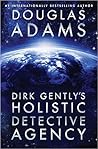
Douglas Adams is one of the best writers of humorous Science Fiction (which is how I am classifying this, though you could, I suppose, call it Fantasy). The interesting thing is that Dirk Gently does not appear until about the mid-point of the book, though he is mentioned in passing a few times earlier. And what Adams does here is to take a number of bizarre threads and tie them all together into a story that makes a weird kind of sense when it is all done. And Dirk ends up being smarter than you first think. I plan to read the follow-up, Long Dark Tea-Time of the Soul.
There aren’t too many people who can write humorous Science Fiction, but Keith Laumer does it in these classic stories. This book starts off the series, and the stories follow a formula, but an enjoyable one. Jame Retief is a lower-level staff member of the diplomatic service Corps Diplomatique Terrestrienne, and is the only one who can see clearly the problems they face. His superiors (always including Magnan) are bureaucratic ass-coverers who always follow the procedures, but Retief manages, by ignoring all of that, to save the day in the end. This is the kind of book you don’t need to sit down and read cover-to-cover. Just pick it up and read a story when you want a lift.
This book starts out as a kind of “cousin” to Harry Potter when Quentin Coldwater gets invited to apply to a college for magic. He has done sleight-of-hand stuff for a few years, but this is a place that teaches real magic, and it turns out Quentin can do it. The first half of the book is about his college years, and the people he befriends there. In the second half it becomes a pastiche of Narnia, which is a bit of a change. But while Harry Potter and Narnia makes it sounds like a book for kids, you should know that sex, drugs, and alcoholism all feature in this book, along with some heavy emotional stuff, so use judgement before giving this to a younger reader. One resemblance is that Quentin’s emotional mess is somewhat like Harry Potter’s. In both cases I wanted to just shake them and tell them stop being so maudlin. It is probably OK for mid-teens and older. While this is not a perfect book, it made me want to continue the series.
I was interested to read this book because I know so little of African history, and this was a good introduction to get an overview of that history. Each chapter is written by a different author, which is good for such an expansive topic since the authors each have their own area of expertise. The book starts in pre-history, looking at the archeological data for early humans settlements, and works through Egypt, Rome, the Arabs, and finally black Africa. It winds up in the colonialism of the nineteenth century and then the de-colonization movements of the twentieth century, finally ending around 1970.
This short story helps flesh out some stuff in The Expanse. If you have read Leviathan Wakes, I would read this next. Most obviously it tells the back-story of one of the main characters from that novel, but another thing it does is to explore and explain some features of Belter psychology that are presented in the novel but may not have fully grabbed your attention. It is a short read, but very worthwhile if you want to explore The Expanse.
You may have seen a TV series called The Expanse. Well, this is the book that started it. Kind of. I have been to a few panels with the author team at SF cons (it is two gentlemen using the James S.A. Corey pseudonym), and I think this all started as a computer game, then they turned it into a book, and then someone really smart realized this could be an awesome TV series. Well, a series that awesome must have come from a pretty good book, and this is one I could not put down. It is great space opera in an area not being covered much these days. It is set in a world where the solar system is being settled, but no one has yet left the solar system. All of the settlements seemed to me to be very plausible. There is one invention you have to give them, the Epstein Drive. But even that is not some kind of hand-waving FTL, it is fully consistent with physics as we know it. Journeys within the solar system take weeks instead of years, but everything has the feeling of reality.
The book starts with mysteries. A ship is destroyed, but why? A girl is missing, but how does that tie in? And gradually the threads come together. There are plot twists a plenty, and an ending that caught me completely by surprise. I have to get started on the second book of the series now.
This is the autobiography of a musician who experienced the psychedelic 60s and lived to tell about it. But it is also the story of a man who screwed up his life with booze and drugs, yet eventually found recovery and peace. I initially wanted to read it because I have been a big fan of Jefferson Airplane since the 1960s, and then a big fan of Hot Tuna, the band Jorma put together with Jack Casady as the Airplane was imploding. Jorma was responsible, in part, for some really great music, but I knew there was more to the story that I had not known, so I was eager to read this. But the story of him turning his life around ended up being at least as important to me. I would recommend it highly to anyone who is either a fan of that music, or is interested in people who recover and turn their life around. IF you are one of those people, pick it up, you won’t regret it.
BTW, I continue to catch Jorma (with or without Hot Tuna) whenever he is in town, and I can see very plainly a man at peace, and I am happy for him.
This is the last of Asimov’s Foundation series, and was published posthumously. One suspects Asimov was feeling the effects of his age, since this novel (more a group of novellas, really) show Seldon growing older and gradually losing everyone in his life he cares about His “wife”, Dors Venabili, is destroyed, his adopted son Raych is killed, his collaborator Yugo Amaryl dies in middle age from overwork…all in all pretty bleak. But it brings everything around again. In the first book, Foundation, we see Seldon as a very old and feeble man confined to a wheelchair, and in this volume we see how he got to that point. But this novel does show how they set up the Foundation, and the Second Foundation, with the idea that the Foundation would focus on the physical sciences, and the Second Foundation would focus on the mental sciences.
I now have this as part of a 7-book set of all of Asimov’s Foundation novels in e-book form.