Tag Archives: Politics

My Review of “Nixonland”

Nixonland: The Rise of a President and the Fracturing of America by Rick Perlstein

This is the second volume in Perlstein’s masterful quadrilogy on the rise of the right in twentieth century America. This long volume covers both the rise of Nixon from his earliest days his political collapse in the early 1960s when he consecutively lost both the Presidency (in 1960) and the Governorship of California in 1962. Then it traces how he worked a resurrection that would see him elected President in 1968, and re-elected in a landslide in 1972. It includes the rise of the anti-war movement in the 1960s, civil rights conflicts, and looks at both the politics of the Republican party and of the Democratic party. It ends with the 1972 election, but of course covers the Watergate break-in and the initial investigations of White House criminality. So it covers a lot, and that means it is not a quick read. It is, however, an indispensable guide to this important period in American history.

Reading it in 2025, as I did, is to see just how much of of the problems we face now originated with Nixon. He really initiated the Imperial Presidency that Trump is trying to complete. Nixon really stated once that if the President does it, it isn’t illegal. But Perlstein makes a more significant point, which is the kind of polarization we now see tearing the country apart really started with Nixon, who stoked it as a path to political power. The big difference between now and then is that in the 1970s there were Republican politicians who valued principles of Americanism. Sadly, we now have a bunch of spineless politicians. There are a few that stand on principles, but not nearly enough to restrain the most corrupt Presidency in American history.


View all my reviews

My Review of The Making of the President 1960

The Making of the President 1960 by Theodore H. White

My rating: 5 of 5 stars


When you look at political history there are some figures that stand above the crowd, and Theodore White is one of them. This was his first book about a presidential election, the election of 1960 that saw John F. Kennedy defeat Richard M. Nixon. White went on to document the following three elections: 1964 (Lyndon Johnson v. Barry Goldwater), 1968 (Richard Nixon v. Hubert Humphrey), and 1972 (Richard Nixon v. George McGovern), and while they are all good books I have enjoyed reading, I personally think this first one was the best. It gives a view of the election as it would have appeared ot people at the time, not as we look back on it. Kennedy has received numerous hagiographies as a result of this assassination, which make him appear better then he really was, while after Watergate Nixon is viewed as irredeemably evil. But neither of them was viewed through those lenses as the election of 1960 took place.

This book won the Pulitzer Prize for General Non-Fiction in 1962.


View all my reviews

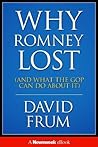
My Review of Why Romney Lost

Why Romney Lost by David Frum

My rating: 3 of 5 stars


This is not Theodore White level analysis, but I am a politics junkie and I love this stuff. Like a lot of people, I consider Obama to be the best president so far in this century, and possibly being the best in my adult life. Frum’s position in this book is that Romney lost more than Obama winning, which I don’t really agree with, but beyond that he pushes the idea the Republican Party has become out-of-touch. I think this is essentially correct, though lately they seem to have gained some traction from outright racism and nationalism. Frum is a life-long Republican who served in W’s administration, so his views have some relevance here.


View all my reviews

Rents and Rent-Seeking

The idea of rent is quite old, going back thousands of years to the ancient world. It originally applied primarily to land, and meant that some people had ownership rights to the land and could demand payment (rent) from anyone who sought to use the land. What tended to happen over time is that land ownership would get concentrated in the hands of a few people ultra-rich people and the rest of the population would become impoverished. At some point this would create pressure leading to land reform, which would mean taking some of the l and from the wealthy and giving it to the lower classes. In Rome (both Republican and Imperial) this frequently meant getting land to give to soldiers who had completed their service. After all, you don’t want a large group of armed veterans who are pissed-off to march on the government.

As the Western world moved into the middle ages the Roman institutions evolved into what we call feudalism, a system whereby the monarch was the legal owner, at least in the first instance, of all the land in the kingdom. The monarch would then distribute land to the nobility in exchange for military service. And the nobility would use their derived ownership of land to extract rent from the peasantry, and turn that relationship into serfdom, in which the peasants were legally prohibited from leaving the land. The serfs would be required to work the lord’s land (this is where the term landlord comes from) in exchange for being able to farm a little bit for themselves. What became clear when people looked closely at this is that feudalism was a very backwards system that was a brake on development, and that it had to be overturned for the industrial revolution to succeed. The first economists, such as Adam Smith, saw this very clearly.

Smith divided the sources of income into three pieces: Rents, Profits, and Wages. Wages are the income to people who work, Profits are the income to the capitalists who invest in machines and raise productivity, and Rents go to people who own land. But what does that mean exactly? To Smith, they were taking money that derived originally from productive activity and devoting it to non-productive enrichment of the already wealthy:

“Ground rents are a species of revenue which the owner, in many cases, enjoys without any care or attention of his own. Ground rents are, therefore, perhaps a species of revenue which best bear to have a particular tax imposed upon them.”

“As soon as the land of any country has all become private property, the landlords, like all other men, love to reap where they never sowed and demand a rent even for its natural produce.”

“A tax upon ground-rents would not raise the rents of houses. It would fall altogether upon the owner of the ground-rent, who acts always as a monopolist, and exacts the greatest rent which can be got for the use of his ground.”

As economists built on Smith’s insights, they expanded the definition of rent to include and payment that is due solely to ownership and not derived from productive activity. A prime example is a monopoly. If I am the sole owner of a desirable resource I can charge a much higher price for it. But the most general definition would include what we used to call “coupon clippers”, people with great wealth, often inherited, that can just live off of the dividends and interest without doing anything productive. Here is the dictionary.com definition:

Rent-seeking = the act or process of using one’s assets and resources to increase one’s share of existing wealth without creating new wealth.

What many people do not realize is that Smith saw clearly that restraining rent-seeking would require government action. He did definitely like what would happen with the development of industry, and but saw that this development was endangered by the rent-seeking behavior of the wealthy. and I submit this is just as true in 2017 as it was in 1776 when Smith published his great work.

Activism 101

As someone who first got politically active in the 1960s as an anti-war activist, I have learned a few things about how to do this. And it starts with the observation that some amount of effort is required to have any chance of success. It doesn’t have to be as big as marching on Washington (fun though that may be) to get something useful done. For example, you can sometimes push a Congresscritter to do some good, and it can be done with a small effort.

What you need to always bear in mind is that in D.C. the first thing every politician cares about is re-election, and you can use that to your advantage. They will look for signs of what is important to their constituents, and that is where you come in. Messages to Senators and Representatives can, if there enough of them, influence their vote. In some cases, they will even go against the wishes of their PAC contributors if they see enough interest from constituents.

You do need to exert some effort, though, to be effective. Here are the ways you can do this, in increasing order of effectiveness:

  1.  E-mail a message – Most politicians have e-mail messaging, which may be a normal e-mail address, or may be a Web form. This is the easiest for you to do, but also the least effective precisely because it is so easy. If you literally have no other option, it is better than nothing, but if you can do better you should. We are assuming you want to be an activist, and that you do in fact care about this, right?
  2. Make a phone call – I have entered into my Contacts list on my phone the e-mail address, the Web site address, and phone numbers for both the Washington office and the local office for my Congressmember and both Senators. I also have the phone number in Lansing (my state capital) for my state Senator and state Representativc. That way I can when necessary phone them immediately about any issue. This is the best thing to do when time is of the essence and a mailed letter may not get there in time. However, many offices have a voice mail that screens calls, and the voice mail box frequently gets full and refuses to accept more messages. Today, for instance, one of my Senators had a full  voice-mail box. When that happens you can try two things: 1) If they have an option to speak to a staff member, try that; or 2) if the DC office is unreachable, call the local office. Pro-tip: Most pols are not, at this point, checking phone callers to see if they are constituents. So give it a try with some other pols outside of where you live.
  3. Write a letter – This is the best bang-for-the-buck solution, and has been ever since my anti-war days in the 1960s. It requires you to write the letter, put it in envelope, address it, put on a stamp, and mail it. And because it requires more effort, your politician will treat that a a signal that you are very serious. That is why it is the most effective. And you can learn some interesting things about your politicians. When I was a young fellow in Massachusetts, I learned that Senator Edward Kennedy really didn’t give a damn about letters from constituents. But Senator Edward Brooke (a Republican in a Democratic state) always replied with letter. Pro-Tip: don’t write a long, detailed analysis. Your politician won’t be reading any of the letters, they will just get a report from a staff member that tells them what the mail shows. So a two sentence letter is fine. And if you get a reply, that was also written by a staff member. You want personal service? Become a major campaign contributor. I don’t make that kind of money, sadly.

Now, these things are the ways ordinary citizens can influence politicians to do some good. And there is nothing that says you have to limit yourself to only one method. I like to hit them with a phone call right away, then write a letter when I get home. I buy a book of the First Class Forever stamps whenever I run low, and I have a box of inexpensive white #10 envelopes, available at any Office supply store. So I am ready at any time to make my voice heard. And while one letter or phone call may not seem like much, it is when the phone lines are jammed by outraged citizens and sacks of mail come pouring in that they take notice. We can all do our part there.

Making a Revolution, 21st Century style

One of the big stories of 2016 has been the two outsider candidates, Donald Trump and Bernie Sanders. They aren’t all that much alike, as it turns out, except in that they diagnose a problem of elite politicians who are out-of-touch with “real Americans.” And there is some validity to that. Still, the fundamental question you would have to answer is how that can be changed.

I am old enough to remember the last time people in the U.S. tossed around the term “revolution” as a solution, which of course was the 1960s. The assassinations, the Vietnam war, the draft, and so on provoked this, but of course this was unrealistic. What actually happened was that the pendulum began to swing back to a more right-wing culture after a fairly long period of liberal ascendancy. This began with Nixon, grew under Reagan, and finally self-immolated with George W. Bush. This opened the door to another swing of the pendulum back towards liberalism (or as the kids say these days, progressivism) that almost got going under Bill Clinton, did really get going under Obama, and will continue under Hillary Clinton.

But change at the top is not how you make a revolution in the 21st Century. And that has been the weakness of the left in this country, and in particular of the young people who made up the Bernie Sanders forces this year. It is great to be inspired by a politician running for President. I get it. I was a McGovern volunteer in my very first Presidential election. And McGovern got the nomination, before being crushed by Nixon. I learned some valuable lessons from that campaign, not least that I should not judge the course of a Presidential election by what I see around me. I lived in the only state McGovern carried, but I was convinced he was going to win because everyone I knew was going to vote for him. But real change starts from the bottom, in your local communities. My cousin Jim, who is a city councilman in Beverly, Massachusetts, could probably give you an inside view, but I think a good way to understand this is with a sports metaphor. You need a good bench to mount a championship run. No baseball team is going to go far without a good bullpen. No football team will make it without depth. And in pretty much any sport you need a deep bench of quality players. Let’s stay with baseball for a moment. The players who will move up to become your bench are developed in the minor leagues, where they hone their skills, and the best of them eventually get called up to the majors. And that is what local politics does, it helps to develop the bench. In your local community there is probably a city council, a school board, a parks commission, and so on. Who are the people that are getting elected to these positions? Do you know? Do they represent your views?

This matters, because at some point the Mayor’s job will open up, a State Representative or State Senator will retire, and guess who will run for those positions? The very same people who started on the City Council, the School Board, or the Parks Commission. They have been building support in the community, collecting political “chits” from local people, and they can leverage that into a run for the higher office. Once they are there, the process repeats. They do the constituent service, they build political support, and eventually a seat in Congress or the Governor’s job opens up, and they are in position to do it again. Rinse, repeat. Do a good job, build your political base, and then you have a shot to move up again. A US Senate seat might open up. Rinse, repeat. And finally you get a shot at running for President. Bernie Sanders’ own history demonstrates this. He initially tried to run for Governor and US Senator in Vermont in the 1970s. And he lost! But then he ran for mayor of Burlington, Vermont in 1981, won that election, and was re-elected three times. Then he ran for U.S. Congress, won and ended up serving 8 terms. From there he ran for U.S. Senate in 2006, and was resoundingly re-elected in 2012 with 71% of the vote. If he had not served those four terms as mayor of Burlington, there would not have been any Bernie Sanders campaign in 2016.

If you don’t make sure there are good people entering the pipeline, you will never have good people to vote for at the highest level, it is as simple as that. At the very least, you should vote. That is how people get into office in this country. Even better is to vote intelligently. And as it happens it is not that hard these days. Most places will have a way to see the ballot before you go to vote. In Michigan, the Secretary of State has a Web site where you can see and print out a sample ballot. Then let Google be your friend. Most candidates will have a Web site these days, and you can get an idea of who is the best candidate in each race. And if you are serious about making a difference, look at doing a spot of volunteering or contributing a few bucks. Every campaign needs that kind of help.

And if you want more information on your state, here is a site for all 50 U.S. states with a series of videos, one per state, and each one is about 2 minutes long, that explains what you need to do. Registration deadlines are coming up, so you need to act, but it is not terribly hard. And really, if you say you want a revolution in this country, this is how you do it.